
Linear Thinking in a Circular World
Let me be real about something that frustrates me every day in this work.
The fashion industry talks about circularity constantly. Brands publish sustainability reports. Certifications multiply. Recycling programs launch with press releases and social campaigns. And yet — the fundamental system hasn’t changed.
The reason isn’t a lack of ambition or even a lack of investment. The reason is that the industry keeps applying linear thinking to a circular problem. We keep trying to fix the end of the line without questioning how the line was designed in the first place.
Until we address that root issue, we will keep failing — not because circular fashion is impossible, but because we’re not asking the right questions at the right moment.
“The industry keeps applying linear thinking to a circular problem. We’re trying to fix the end of the line without questioning how the line was designed.”
The Linear Model Is Not a Bug — It Was the Feature
To understand why fashion keeps failing at circularity, you have to understand what the industry was actually designed to do. The linear model — take, make, use, dispose — wasn’t an accident. It was a feature. It drove growth. It made production cheaper, faster, and more scalable. For decades, the cost of that model was externalized: paid by ecosystems, by communities near factories, by workers absorbing degraded conditions, by the atmosphere absorbing emissions.
That model is deeply embedded. Not just in supply chains, but in design culture, business models, consumer expectations, and the metrics companies use to measure success. Circular thinking asks all of those things to change simultaneously — and that’s exactly why surface-level interventions keep falling short.
When production doubled globally between 2000 and 2015 while the number of times garments were actually worn before disposal dropped by more than a third, that wasn’t a failure of recycling infrastructure. It was a failure of design intent.
What Linear Thinking Actually Looks Like
Linear thinking in circular disguise shows up in patterns I see constantly across the brands I work with. It’s worth naming them specifically, because they’re often celebrated as progress when they’re actually holding the industry in place.
Downstream-first problem solving
The most common version: a brand designs a product without any consideration for end-of-life, then launches a take-back program to manage the problem after the fact. The program is real. The effort is real. But it’s a downstream fix for an upstream design failure. If the garment uses blended fibers that can’t be separated for recycling, or hardware that contaminates the textile stream, the take-back program is collecting material it can’t actually process. The circular claim doesn’t hold up under scrutiny.
Material substitution without systems thinking
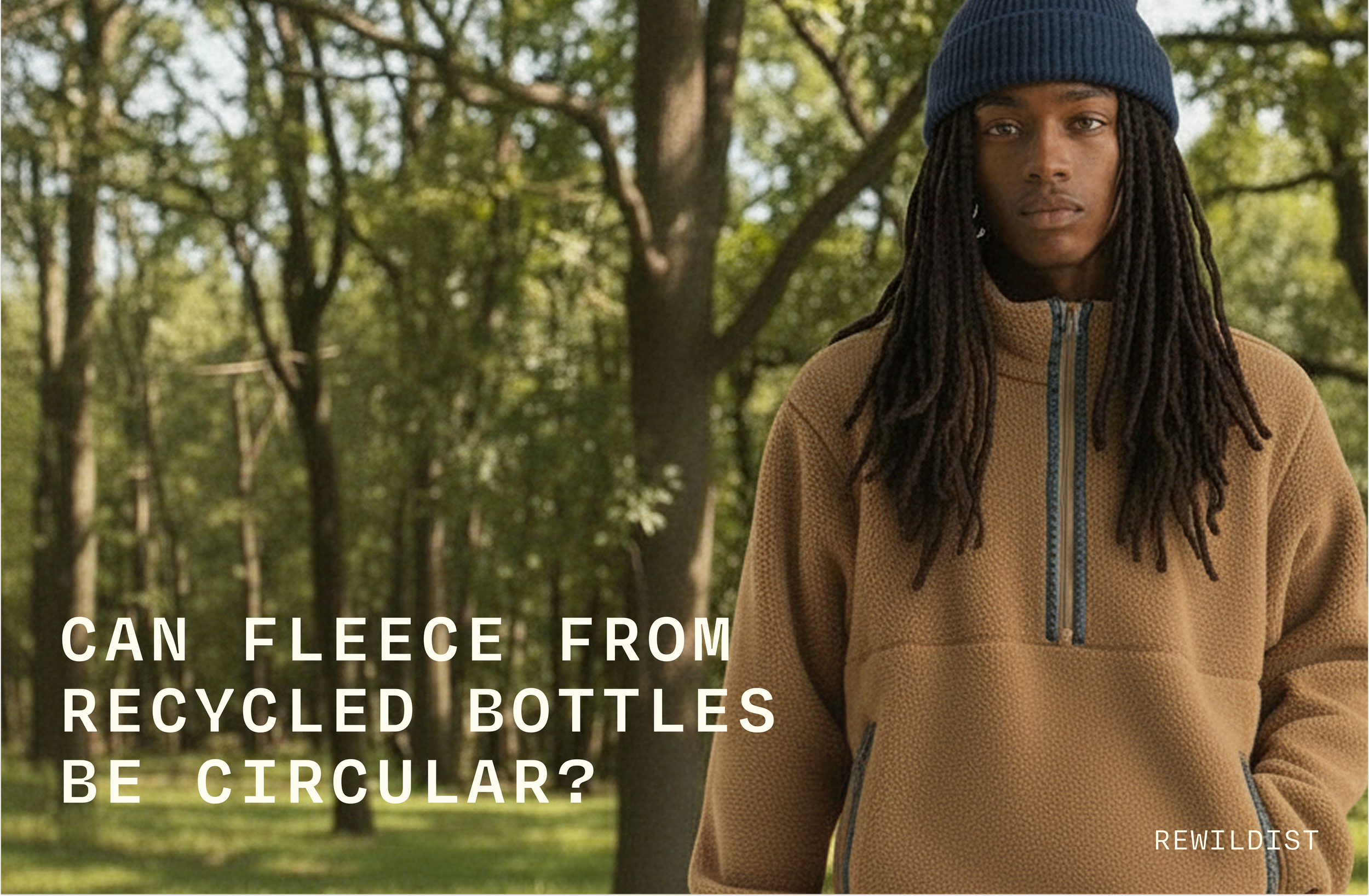
Swapping virgin polyester for recycled polyester from plastic bottles is frequently positioned as a circular move. It’s a marginal improvement in some narrow comparisons — but it’s not circularity. The material still sheds microfibers. It still can’t be recycled back into textile again at scale. And using bottles as fiber feedstock often diverts them from a more efficient closed loop (bottle-to-bottle) into a less efficient one (bottle-to-textile-to-landfill). The EU has already signaled this matters — their sustainable textiles strategy explicitly discourages bottle-to-textile claims and pushes toward fiber-to-fiber recycling instead.
This is what systems thinkers mean when they say that not every closed loop is a healthy one. You can create a loop and still be cycling harm.
What-it’s-not marketing
The industry has become fluent in a particular kind of claim: plastic-free, PFC-free, PFAS-free, toxin-free. These statements tell you what a product is not. They almost never tell you what it is — what replaced those materials, what the actual inputs are, what the end-of-life pathway looks like. When your entire sustainability narrative is built on negation, you’ve traded the appearance of transparency for actual transparency. Greenwashing often lives exactly there, in the gap between what’s claimed and what’s evidenced.
Efficiency gains without systemic change
Eco-efficiency — doing more with less — is genuinely valuable. Reducing water use per unit, cutting material waste in cutting rooms, lowering emissions per garment: these things matter and should be done. But they don’t change the underlying trajectory of a business predicated on continuous growth in volume. If you reduce your packaging weight by 29% and then grow sales 5% year-over-year, you’ve erased those savings within a decade. Efficiency optimizes the linear system. Circularity requires replacing it.
“Upstream design decisions determine the vast majority of a product’s environmental impact. By the time a garment reaches the recycling bin, most of the leverage is already gone.”
The Upstream Opportunity the Industry Keeps Missing
Here’s the thing the industry consistently underestimates: upstream design decisions determine the vast majority of a product’s environmental impact. By the time a garment reaches the recycling bin, most of the leverage is already gone.
The material choices made at the fiber stage shape water impact, chemical exposure, and recyclability downstream. The construction methods chosen in development — whether a zipper is serviceable, whether seams can be taken apart, whether the garment is built to last or built to be replaced — determine whether any end-of-life solution is even possible. The technical specifications written before a single sample is cut define whether the product can be circular at all.
This is where the real work happens. Not at the take-back bin. Not in the resale marketplace. At the design table, in the spec sheet, in the material selection meeting, in the conversation with a manufacturer about what’s actually feasible.
A few concrete examples from the technical realities I work with:
Fleece and microfiber pollution. Fleece is one of the most popular materials in outdoor performance apparel. It’s also one of the most significant sources of microfiber pollution in waterways. Every wash cycle releases thousands of synthetic fibers too small to be caught by standard filtration. This isn’t a problem that can be solved at end-of-life — it’s built into the material choice and the garment construction from the beginning.
Zipper and hardware specifications. A zipper that can’t be replaced makes the garment non-repairable. A metal hardware component bonded into a synthetic fabric makes the garment non-recyclable. These decisions happen in the development phase and feel minor — until you’re trying to extend the life of a product or recover its materials and realize the design made both impossible.
Fiber blends and recyclability. Adding synthetic fibers to natural fibers can increase durability — but it often destroys recyclability. The durability-vs-recovery trade-off is real, and it’s not always solvable yet. But you can only navigate it intentionally if you’re thinking about it at the design stage. Most brands aren’t.
Why This Keeps Happening
I want to be careful here not to make this a simple story about bad intentions. The brands I work with mostly want to do better. The people in design and development rooms are often genuinely motivated. The problem is structural.
Circular design requires holding more variables simultaneously than linear design does. You’re not just asking “what performs best for the customer?” — you’re asking what performs best for the customer while also being traceable, while also being made from materials that can be recovered, while also being designed to last long enough to justify its production footprint, while also being serviceable when it eventually needs repair. That’s a harder design problem. It takes longer, it costs more to prototype, and it often runs into supply chain limitations that make the circular option unavailable or prohibitively expensive at scale.
Timelines don’t help. Most product development cycles run 12-18 months. Sustainability decisions get layered in after the core product brief is set — which means they’re retrofitting circular thinking onto a linear foundation rather than building from circular principles from the start.
And the incentives are still mostly misaligned. Companies are rewarded for throughput, not for longevity. For volume, not for repairability. The business model pressure toward linear thinking doesn’t disappear just because the brand has a sustainability target.
What Circular Thinking Actually Requires
Circularity is not a product feature. It’s a design orientation — a way of asking questions before the first line is drawn, the first material is selected, the first spec is written.
It means asking: Where does this material come from, and what does extracting it cost? Who processes it, and under what conditions? What happens when the garment is worn, washed, repaired, or damaged? What happens when the customer no longer needs it? Can it be returned to the system in some form? If not, why not — and is there a design choice that would change that?
These questions are not easy to answer. In many cases, the honest answer is: we don’t know yet, or the infrastructure doesn’t exist yet to make this fully circular. That honesty matters. Progress over perfection is real — but progress has to be grounded in accurate understanding of where the barriers actually are.
The Cradle to Cradle design framework has been making this argument for decades: products must be intentionally designed for safe cycling, material health, and continued value from the beginning. Not collected at the end and hoped to be recoverable. Designed to be circular from the start.
The difference between those two approaches is the difference between circular fashion as a downstream program and circular fashion as a design discipline.
“Circularity is not a product feature. It’s a design orientation — a way of asking questions before the first line is drawn, the first material selected, the first spec written.”
Where to Go from Here
I’m not writing this to be discouraging. I’m writing it because I think the industry is capable of more than it’s currently delivering — and I think one of the things holding it back is a lack of honest diagnosis.
If you’re working in product development, in sourcing, in sustainability, or in brand leadership: the most powerful thing you can do is shift the conversation upstream. Not just “what can we do with this product at the end of its life,” but “what decisions at the beginning of this product’s life determine whether circularity is even possible?”
That shift in timing is the shift in thinking the industry most needs. Downstream solutions will always be necessary — but they’re most powerful when they’re recovering products that were designed to be recoverable in the first place.
Linear thinking built the industry we have. Circular thinking, applied at the right moment, can build something better. But it starts upstream.