I Thought Organic Was The Answer. Soil Health Is the Standard.
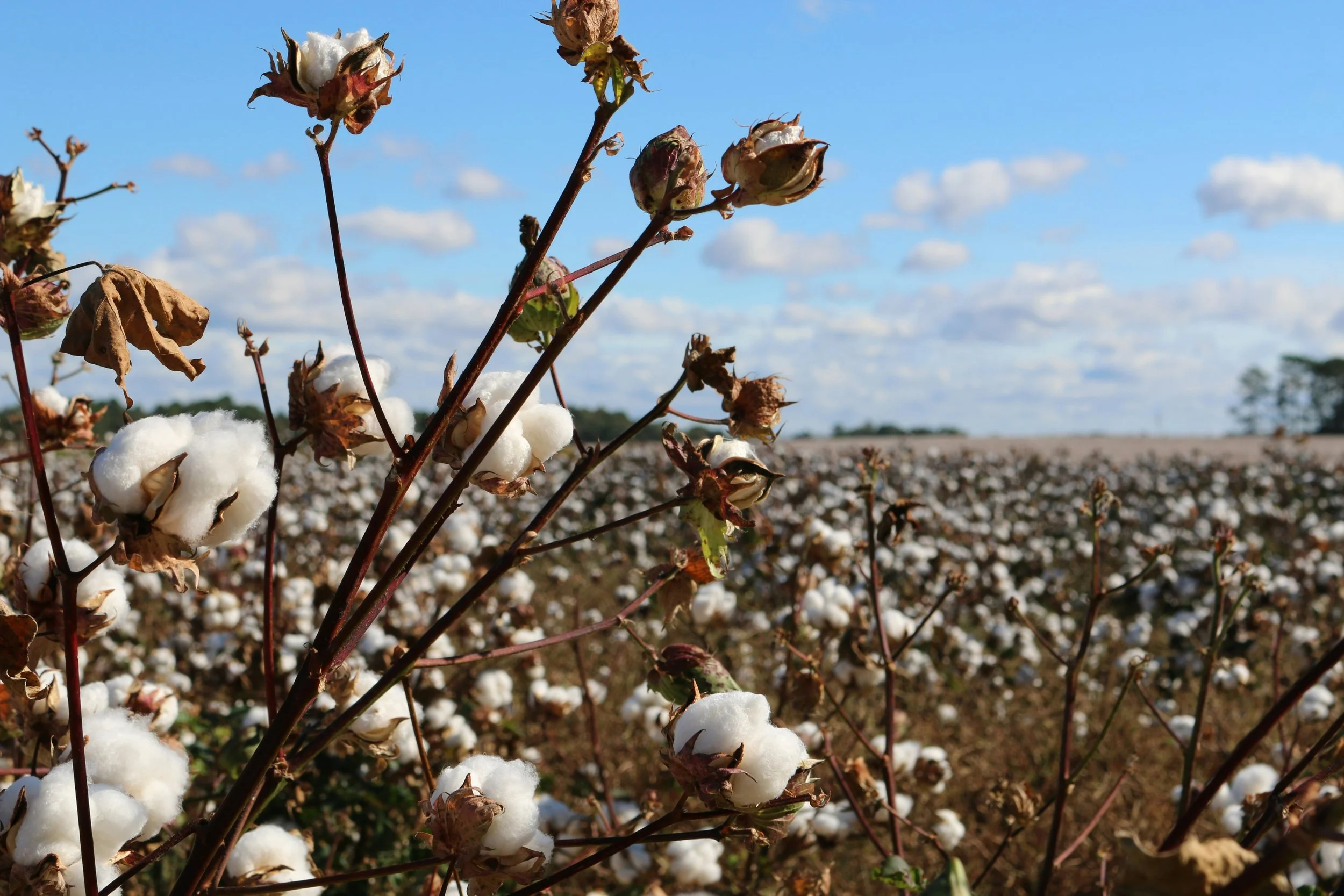
For years, organic was the answer. I sourced to it, believed in it, told brands it was the line to hold.
Then I watched Larkin Martin speak.
Martin is a seventh-generation farmer in Courtland, Alabama. Her family has been working the same land for nearly 200 years. She's a director of the Soil Health Institute, has partnered with The North Face and Imogene + Willie, and has spent her career doing the work the textile industry now calls regenerative agriculture — cover crops, no-till, crop rotation — before the word existed as a marketing term. She didn't need a certification. She had 200 years of evidence in the ground.
She was direct about why. "We were motivated by economic problems." Soil erosion was destroying her most important capital — the top six inches of topsoil. Nematodes were suffocating cotton yields. The solutions weren't chemical. They were biological. And the farm didn't become regenerative because it was a movement. It became regenerative because it was the only way to keep the farm alive.
That's when I started questioning what organic certification was actually measuring.
What Organic Certifies — and What It Doesn't
Organic is an input restriction framework. It tells you what wasn't applied to a field: no synthetic pesticides, no synthetic fertilizers, no GMOs. That matters. But it doesn't tell you what's happening below your feet.
A field can be certified organic and still be tilled aggressively, monocropped season after season, and left biologically depleted. The certification audits inputs. Nobody measures outcomes.
Soil organic matter. Microbial diversity. Carbon sequestration. Water retention. These are the metrics that determine whether a piece of land is getting better or worse. Organic certification requires none of them.
Global organic production — including Fair Trade — accounts for roughly 1.4% of global agricultural output. Part of that is economics: certification costs are punishing for small farms. But part of it is something more honest. Many of the best farmers in the world are doing the right things and simply can't or won't chase a label that doesn't reflect what they're actually building.
What Regenerative Measures Instead
Regenerative agriculture is an outcomes-based framework. The question isn't what you didn't apply. It's whether the land is getting better.
The primary mechanism is nitrogen. Conventional farming replaces soil nitrogen with synthetic fertilizer — fast, but it bypasses the biological systems that make soil productive long-term. Organic restricts synthetic inputs but still depends on approved external amendments. Both approaches are feeding the soil from outside.
Regenerative farming asks: can the farm grow its own nitrogen?
Nitrogen-fixing cover crops — legumes like vetch, clover, sunn hemp — capture atmospheric nitrogen through root nodules and release it for the next crop. The field builds its own fertility. Inputs go down over time. Soil organic matter increases. The system becomes self-reinforcing.
A 2025 Rodale Institute study on hemp made this tangible: the highest fiber quality — strongest tensile strength, best modulus of elasticity — came from no-till, cover-cropped plots with zero added nitrogen. More nitrogen produced more plant. It produced weaker fiber. This isn't just a sustainability argument. It's a product quality argument.
Why Organic Fails in the South — and Why That Matters
Alabama and Georgia grow some of the most interesting regenerative cotton in the country. They also make organic certification nearly impossible to maintain.
The humid Southeast carries pest pressure that doesn't exist elsewhere — nematodes, thrips, stink bugs, boll weevil history. For a small farm without a chemical backstop, one bad season is catastrophic. Organic certification's binary input rules don't flex for regional biology. You either qualify or you don't, regardless of what you're building in the soil.
Martin's farm — genuinely regenerative, verifiably improving soil health across decades, a supplier to The North Face — doesn't carry an organic certification. The land is doing more than most certified organic farms. The label just doesn't fit the biology.
This is the tension brands need to understand before defaulting to organic as their sourcing shorthand.
The Certification Landscape: What to Know
Not all certifications are equal, and the distinctions matter at the sourcing desk.
Regenerative Organic Certified (ROC) — The strongest standard currently available. USDA Organic is the baseline; ROC adds verified soil health outcomes, animal welfare, and farm labor requirements. Bronze/Silver/Gold tiers allow farms to enter during transition. Founded by Patagonia, Rodale Institute, and Dr. Bronner's. Best for: brands wanting the highest verified standard for cotton, fiber crops, and wool.
GOTS (Global Organic Textile Standard) — Organic at the fiber level plus chemical safety and labor standards through the full supply chain. Doesn't measure soil health outcomes. Best for: verifying processing and manufacturing integrity on top of organic fiber.
OCS (Organic Content Standard) — Verifies percentage of organic material and chain of custody only. No environmental or social processing requirements. Best for: tracking organic content claims, not land practice.
Fibershed Climate Beneficial Verified — Measures actual carbon drawdown at the farm level through carbon farm planning and soil testing. Applies to both cotton and wool. Best for: brands making credible climate claims tied to fiber sourcing.
Regenerative Cotton Standard (RCS) — Designed for small-scale farmers using regenerative practices who don't fit the ROC framework. Focuses on farm resilience, ecosystem restoration, and rural communities. Best for: sourcing U.S. cotton outside the ROC pipeline.
U.S. Regenerative Cotton Fund (USRCF) — Active across 10 states representing 85% of U.S. cotton production. Building the measurement infrastructure to document regenerative outcomes at scale. Best for: brands invested in domestic cotton with verifiable soil health tracking.
How Soil Health Is Now Being Measured
The barrier to outcomes-based verification used to be cost and speed. That's changing.
Soil test kits and lab analysis remain the ground truth — measuring soil organic matter, nitrogen levels, microbial activity, and carbon content directly. Standard for any credible regenerative verification program.
Satellite imagery + machine learning can now estimate soil organic carbon across entire fields, tracking change across seasons and flagging erosion risk at a resolution that wasn't commercially viable five years ago. UAV-based imagery achieves even finer resolution for farm-level monitoring.
Biogeochemical modeling — Indigo Ag's DayCent-CR model, peer-reviewed and approved by the Climate Action Reserve, uses field data and modeling to quantify soil carbon change with documented uncertainty ranges. The first agricultural carbon approach to achieve both registry approval and academic peer review.
Carbon Farm Planning — Fibershed's approach, used in the Climate Beneficial program, combines soil baseline measurement, practice documentation, and ongoing monitoring to build a verifiable picture of a farm's carbon trajectory over time.
For brands, these tools mean one thing: the claim "we can't verify regenerative practice" is no longer true. The measurement infrastructure exists. The question is whether you're requiring it.
Wool: Where Regenerative Has Always Lived
For wool, the organic vs. regenerative framing almost doesn't apply. Pasture management has always been outcomes-based. You can't certify your way to healthy rangeland.
Rotational grazing — moving sheep through pasture sections and allowing recovery before returning — is regenerative practice at its most direct. Manure deposition feeds the pasture. Hoof action breaks soil crust. The sheep and the land are in a feedback loop that builds rather than depletes when managed correctly.
The most credible wool certifications already reflect this. Notably, several now require measuring outcomes against a baseline — which is exactly what organic never asked for.
ZQRX (New Zealand Merino) The most rigorous regenerative standard in wool. Builds on ZQ's animal welfare and social standards with Ecological Outcome Verification (EOV) developed in partnership with the Savory Institute. EOV measures actual ecological outcomes — soil health, biodiversity, water cycles, carbon — against a verified baseline over time. This is outcomes-based verification, not input restriction. Best for: brands making credible regenerative claims with merino as a core material.
ZQ Merino Combines fiber quality grading with animal welfare and environmental responsibility. Long-term grower contracts support stable farmer livelihoods and promote transparency from farm to fabric. A strong baseline standard — ZQRX is the regenerative tier above it. Best for: brands wanting verified animal welfare and quality consistency without full regenerative verification.
NATIVA Regen A regenerative agriculture program applied to Merino farms across the U.S., Australia, New Zealand, Argentina, and Uruguay. Builds on RWS standards with added focus on soil health, biodiversity, water quality, carbon sequestration, and farmer livelihoods. Blockchain traceability links finished wool back to specific regenerative farms. Best for: brands needing multi-origin regenerative merino with digital traceability.
Woolmark Nature Positive Farming Woolmark's regenerative verification program, measuring ecological improvements against a farm-level baseline. Covers soil health, biodiversity, water cycles, carbon storage, and long-term land health alongside livestock welfare and farmer resilience. The baseline measurement requirement puts it in the outcomes camp — not just input restriction. Best for: brands sourcing Australian wool who want a recognized program with ecological outcome tracking.
Origen Ensures traceability and responsible practices from farm to wool tops, supported by Land to Market's Ecological Outcome Verification for soil regeneration measurement. Also achieves Carbon Neutral and Cradle to Cradle certifications. Best for: brands wanting full traceability with verified soil regeneration and carbon claims in a single framework.
RWS (Responsible Wool Standard) Covers animal welfare and land management practices including progressive grazing management, with chain of custody to the finished product. Bans mulesing. A solid ethical baseline but does not measure regenerative outcomes. Best for: brands establishing a minimum ethical standard across their wool portfolio before layering regenerative verification.
Fibershed Climate Beneficial Verified The most rigorous land-outcome standard currently available for U.S. wool. Measures actual carbon drawdown through carbon farm planning and direct soil testing. Applies to both wool and cotton producers. Best for: brands making climate claims tied specifically to domestic fiber sourcing.
Best Practices for Brands: What to Actually Do
1. Stop treating organic as a destination. Organic is a floor. Ask your suppliers what's happening to soil organic matter over time. If they can't answer, that's a gap worth naming.
2. Ask for soil data, not just certification. Certified organic with degrading soil is a worse sourcing decision than regenerative-practice farming with improving soil health. Request soil organic matter baselines and trends where possible.
3. Understand your fiber's geography. Organic certification means something different in rainy Alabama than it does in dryland New Mexico. Regional biology matters. Ask how pest management decisions are made before assuming certification tells the whole story.
4. Invest before the crop, not after. Imogene + Willie paid a 25% premium on a 22-acre crop before it was planted. That's what it looks like to fund regenerative transition rather than reward it retroactively with a sourcing contract. Small brands can do this at scale with fewer farms and longer relationships.
5. Use ROC as your premium standard, not your baseline. ROC is the best convergence of organic inputs and regenerative outcomes currently available. Treat it as the target for key raw material categories, not the minimum.
6. Track the measurement tools. Fibershed's Climate Beneficial, the USRCF, and Indigo Ag's carbon programs are building the verification infrastructure for regenerative claims. Engage with them now. The brands that build these supplier relationships early will have a sourcing story no one else can replicate in three years.
7. Design for the loop. Regenerative fiber only closes the circular loop if end-of-life is planned. Natural fiber returns nitrogen and organic matter to soil — but only if it reaches soil. Design for biodegradability, durability, and take-back from the start.
Closing Thought:
Organic drew a line in the right direction. Regenerative is asking what's on the other side of it.
The question is no longer whether you're sourcing organic. It's whether the land your fiber came from is getting better or worse. We now have the tools to find out.