The Future of Circular Fashion Is Being Built in Europe. Is Your Brand Ready?
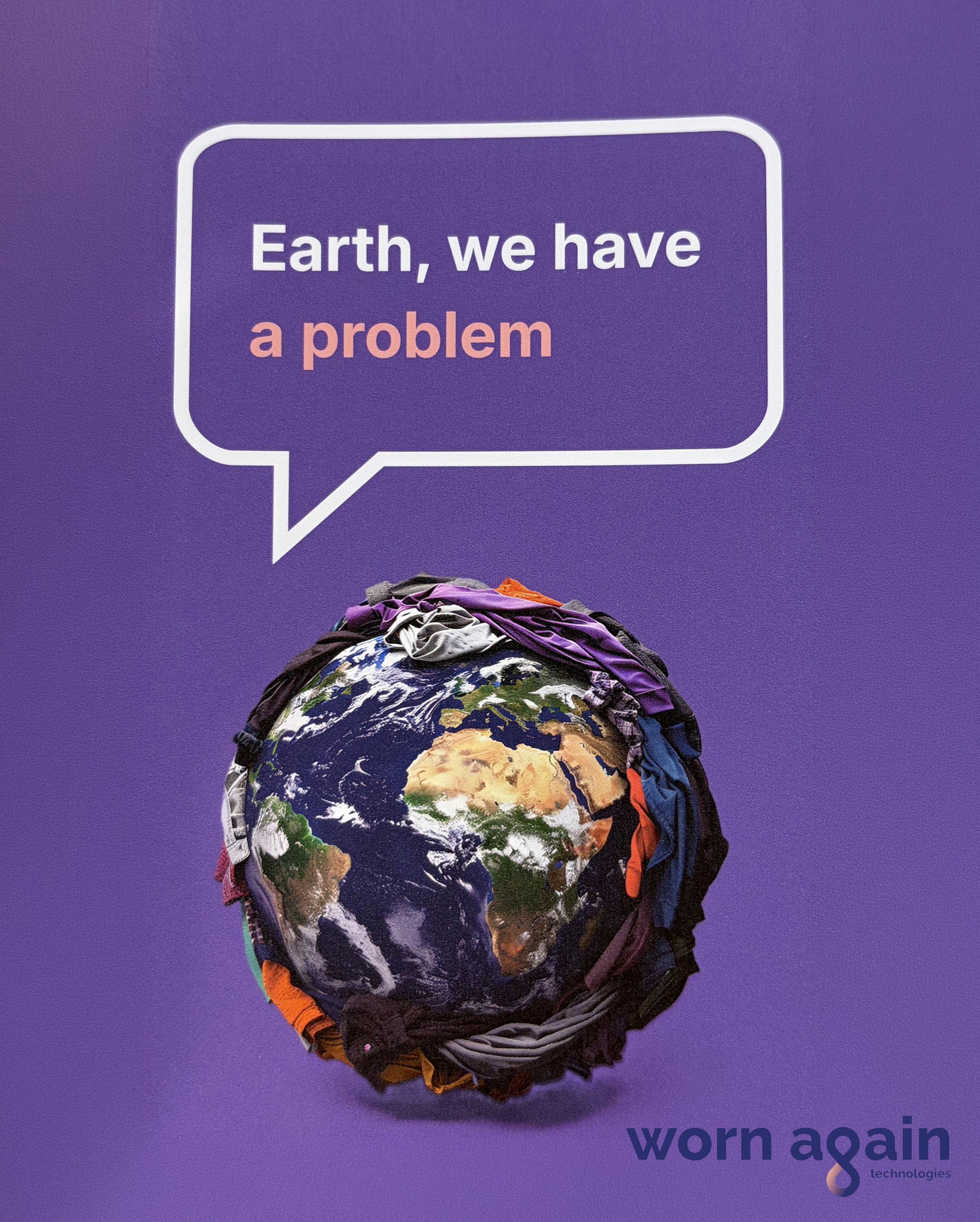
I came to Europe knowing the conversation had already shifted — not whether circular fashion would happen, but how quickly it could scale. I didn't come looking for new ideas. I came because I always learn more when I'm in the room.
I've spent more than 25 years in sustainable fibers and circular supply chains — as CPO, as a product developer, as a founder. I've watched "sustainable fashion" move from fringe conversation to marketing checkbox. I've watched greenwashing become an artform. Circularity has always felt like the real answer — not a trend, but a design philosophy that forces accountability at every level of the supply chain.
So I planned what I've been calling my own growth tour: starting with two shows I've wanted to attend for years — the Textile Recycling Expo and the Future Fabrics Expo — followed by supplier visits and mill tours in Italy, where I'm writing this now, still in the thick of it. Finishing this trip in Portugal.
Walking those floors confirmed what I already believed, and pushed it further. Europe isn't experimenting with circular fashion anymore — it's building the systems that make it inevitable. And what I keep coming back to is this: the biggest gap right now isn't technology.
It's adoption.
1. Europe Is Building Infrastructure, Not Ideas
For years, the honest answer to "why aren't brands designing for recyclability?" was: because the end-of-life infrastructure doesn't exist. That excuse is disappearing.
What struck me most walking the expo floors wasn't any single technology. It was the system. AI-powered textile sorting — the same near-infrared sensor technology that transformed plastic recycling — is now mainstream in European textile streams. Garments are sorted by fiber composition at scale, baled, and routed to the appropriate recycler. The EU's Waste Framework Directive mandated separate textile collection across member states by 2025, and the industry built infrastructure to meet it.
That's how policy and innovation are supposed to work together. The regulatory floor created the market. The market attracted the capital. The capital built the systems.
Pre-consumer and post-consumer textile streams are both being processed. The collaboration between sorters, recyclers, brands, and policymakers — which used to feel aspirational — is operational. Not everywhere, not at full scale, but directionally and unmistakably real.
For US brands, this matters more than it might seem. The end-of-life pathway for well-designed garments now exists in Europe. If you design correctly — mono-material or even considered blends, no problematic finishes — your product can re-enter the supply chain. The infrastructure argument for not designing with recyclability in mind is gone.
2. The Material Revolution Is Already Here
Every material challenge the industry has pointed to for the last decade now has companies actively solving it. What surprised me wasn't any single breakthrough — it was how many fronts this is happening on simultaneously.
On recycling: The old rPET story — recycled polyester from plastic bottles — was always a workaround. Bottle-to-textile is downcycling, not recycling, and it diverts material from a packaging loop that already works. The European Commission now explicitly pushes the fashion industry toward dedicated textile-to-textile recycling, and the technology is catching up. Chemical recyclers like Syre and Reju are breaking polyester back to its original monomers — producing virgin-quality fiber with no degradation, cycle after cycle. Enzymatic innovators like Samsara Eco use plastic-eating enzymes to handle blended textiles at lower temperatures and energy inputs. French startup Recyc'Elit has produced the first finished garment made entirely from chemically recovered textile waste — separating polyester, elastane, and cotton and recovering each material intact. The infinite loop isn't theoretical anymore.
On bio-based inputs: There is enough synthetic material in the world. We don't need to keep making nylon from petroleum. OzoneBio, a Canadian company, is producing bio-based Nylon 66 from wood waste using a process that cuts CO2 emissions by 96% versus conventional production — and they've achieved a world first, spinning it into actual yarn. Companies like Arda are turning spent grain proteins into plastic-free polymers. Rheom Materials is producing bio-based leather alternatives and biopolymer resins as direct replacements for petrochemical materials. The fossil-free front end is real and scaling.
On stretch: Elastane is in roughly 95% of our baselayers, underwear, and activewear — and it has made those garments largely ineligible for recycling. That is changing. Hyosung now offers bio-elastane from sugarcane alongside GRS-certified recycled options. The Lycra Company is developing fibers designed to be extracted and re-entered into the supply chain. Italy's XLance offers a polyolefin-based elastomer that is solvent-free, lower-energy, sheds dramatically fewer microplastics, and carries a better recyclability profile than polyurethane elastane. Bioastra is developing fully bio-based and recyclable elastomers. The stretch circularity gap is not closed — but it is being closed.
On color: Dyeing discharges an estimated 200,000 tons of toxic chemicals into waterways globally every year. What I saw at the shows was a genuine inflection point in bio-based color. Algaeing's algae-powered dyes are at industrial scale and tripling production in 2025. Post Carbon Lab turns CO2 into industrial colors using photosynthetic microbes. Octarine Bio has bio-based dyes at price parity with conventional chemistry. Caffè Inc. extracts colorants from spent airport coffee grounds. The point isn't the individual companies — it's that an ecosystem of circular color solutions now exists, and some of them are commercially ready today.
The conversation I heard over and over on these floors: we have the technology. What we need now is brands willing to design for it.
3. Circular Design Is Becoming Better Design
This is where I want to push back on how most brands think about circularity.
It's not a sustainability initiative you layer onto the product after the design is done. It's a design methodology. And when you apply it rigorously, it doesn't compromise the product — it makes you a sharper, more intentional designer.
Designing for circularity means asking, from the first sketch: How does this come apart? What happens to each material at the end of its life? Are the dyes and finishes compatible with recycling or composting? Are the trims — zippers, labels, hardware — designed to be separated? Is the fiber blend necessary, or can a mono-material construction achieve the same performance?
These aren't constraints. They're design parameters. And the brands I've seen apply them rigorously don't end up with compromised products. They end up with products that are cleaner, more considered, and easier to talk about honestly — because the story is true.
The biggest surprise for me at the shows wasn't a new fiber or a recycling technology. It was how many designers and developers are now fluent in end-of-life thinking from the beginning of the process. That fluency used to be rare. In the European brands and mills I've been meeting, it's becoming standard.
For US brands, this is both an opportunity and a warning. The brands building this capability now — the technical knowledge, the supplier relationships, the design protocols — will have a structural advantage that is very hard to replicate quickly. Circular design competency is not something you can outsource at the last minute when regulation arrives.
4. Regeneration Is the Next Baseline
A word of caution first: "regenerative" is already attracting the same greenwashing risk as "sustainable" and "eco-friendly" before it. The concern is legitimate, and the solution is the same — traceability, certification, and verified outcomes.
But the underlying practice is genuinely transformative. Regenerative agriculture — crop rotation, cover cropping, no-till farming, agroforestry — restores soil health, sequesters carbon, reduces synthetic inputs, and strengthens farming communities. For natural fiber brands, it reaches further into the supply chain than any previous standard.
The numbers from credible projects are striking. A regenerative cotton project developed by SÖKTAŞ with LVMH and Stella McCartney delivered a 26-metric-ton-per-hectare increase in Soil Organic Carbon over four years, eliminated herbicides entirely, reduced water use by 62%, and generated enough carbon offset to cover the full footprint of fiber, yarn, and fabric production.
Textile Exchange published credible regenerative agriculture claims guidance in 2025. Certification pathways through Regenagri and Textile Exchange's emerging standard are giving brands the tools to make verifiable claims. For natural fiber brands, regenerative sourcing is moving from differentiation to baseline expectation — and the brands building direct farmer relationships now will have supply chain advantages that are hard to replicate later.
5. What US Brands Should Do Now
This is the part I keep coming back to. Europe isn't waiting. The policy is moving, the infrastructure is building, and the brands that are designing for this now will look very different from those that aren't in five years.
Here's what I would do if I were leading product at a US brand today.
Design for end-of-life from the first sketch. Don't assume recycling infrastructure will catch up to whatever you build. Choose materials with a known end-of-life pathway. Minimize fiber blends. Avoid finishes that contaminate recycling streams. Ask your material suppliers what happens to their fiber at end of life — and expect a real answer.
Know your materials at the chemistry level. Recycled content on a hangtag is the beginning of the story, not the end. What process created that recycled fiber? What chemicals were used? Where do they go? What's the actual CO2 footprint, not the estimated average? Brands that can answer these questions will be positioned for traceability requirements. Brands that can't will be scrambling.
Treat traceability as competitive advantage, not compliance burden. The Digital Product Passport is coming for any brand selling into EU markets. Extended Producer Responsibility legislation is advancing in California, New York, and federally. Brands that build supply chain transparency now — knowing their tier-two and tier-three suppliers, their farms, their chemical inputs — will have assets that late movers will spend years trying to build.
Think beyond recycled content. Circularity is not putting recycled polyester in a hangtag and calling it sustainable. It's designing a product that can re-enter the supply chain at end of life, at full material value, without degradation. That requires different material choices, different construction, different supplier relationships, and different end-of-life planning. The brands that understand this distinction are the ones I want to work with.
Prepare for regulation before you're forced to. Ecodesign regulations, DPPs, EPR — these are not European problems. They are coming to the US market, and the timeline is shorter than most brands think. California's Responsible Textile Recovery Act is already law. New York's frameworks are advancing. Federal labeling conversations are live. The brands that treat European regulation as a preview rather than a foreign concern will be ready. The others will be reactive.
The Question Isn't Whether. It's When.
I came to Europe to learn. I always do.
What I found this time was different in scale: not ideas, but systems. Infrastructure. An industry that has moved from asking whether circular fashion is possible to building the mechanisms that make it inevitable.
The technology exists. The recycling infrastructure is scaling. The material innovations are real and commercially available. The regulatory framework is advancing on both sides of the Atlantic.
The future of fashion isn't being imagined in Europe anymore. It's being built.
The only question left for US brands is whether they'll lead — or spend the next decade trying to catch up.
__
Bonie Shupe is the founder of Rewildist, a technical product design and development consultancy specializing in sustainable and outdoor active apparel, and co-founder of Circular People, a curated marketplace for verified circular products. She has 25+ years in sustainable fibers and circular supply chains.